Sigma Corporation is a Japanese company mainly engaged in the production of single lens reflex camera lenses. Founded in 1961, the company only has factories in Japan and mainly produces 135 format camera lenses. Including Canon mount/Nikon mount/Sony mount and other DSLR micro mount lenses.
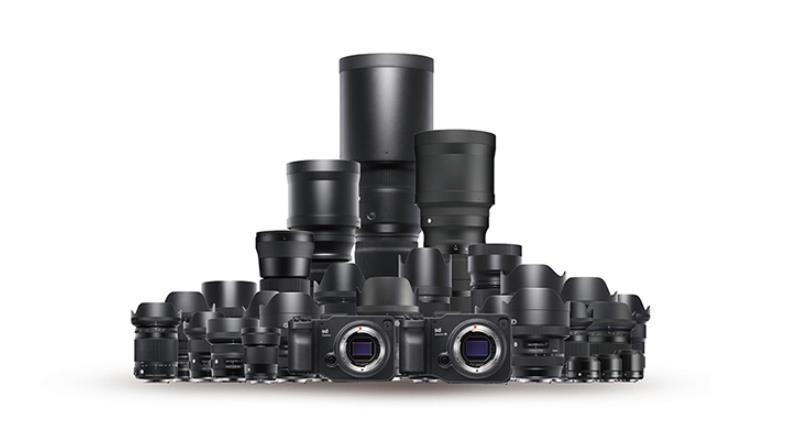
1、 Sigma SGV lens
In 2012, Sigma reorganized all its interchangeable lenses into three product lines. These lenses are collectively referred to as Sigma Global Vision (SGV) new lenses.
A-series (Art): emphasizes optical performance and expressive ability, used for high artistic photography such as portraits and landscapes. It will be used for large aperture focusing lenses, wide-angle lenses, ultra wide angle lenses, macro lenses, and fisheye lenses. Such as Art 14-24mm F2.8 DG HSM.
C-series (Contemporary, Fashion): emphasizes lightness and can be used for most shooting needs. It will be used for standard, telephoto, and telephoto zoom lenses. Such as Contemporary 17-70mm F2.8-4 DC MACRO OS HSM.
S series (Sports): emphasizes the ability to capture high-speed movements, used for high-speed dynamic shooting such as sports. It will be used for zoom and fixed focus lenses for telephoto and ultra telephoto purposes. Such as Sports 70-200mm F2.8 DG OS HSM.
2、 The meaning of Sigma lens models
Taking Sigma 70-200mm F2.8 DG OS HSM Sports as an example for illustration.
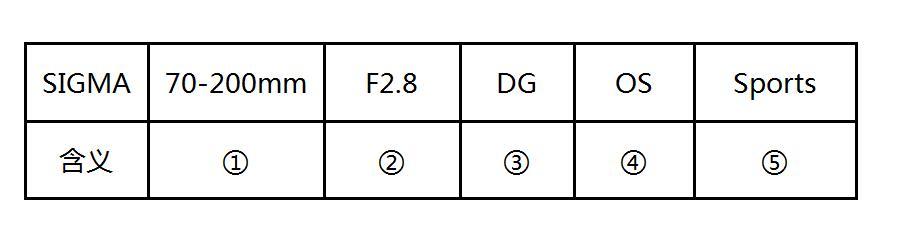
① 70-200mm: indicates the focal length range of the lens. The fixed focus lens is represented by a single numerical value, such as 50mm. The zoom lens is marked with a minimum focal length of 70mm and a maximum focal length of 200mm
② Indicates the maximum aperture of the lens. Fixed focus lenses are represented by a single numerical value, such as f/1.8. If the maximum aperture of a zoom lens is a constant aperture, it is represented by a single numerical value such as f/2.8. For lenses where the maximum aperture varies with the focal length, two numerical values are used to represent the maximum aperture at the wide-angle and telephoto ends, respectively, such as f/2.8-4.
③ DG. The acronym for the English word "Digital Grade". A series of lenses optimized for digital single lens reflex cameras (DSLRs), suitable for full frame and APS-C format camera bodies.
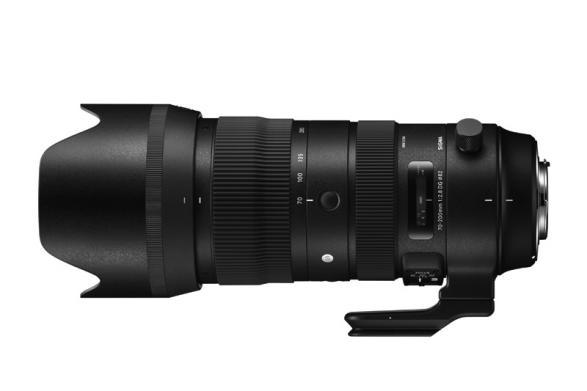
④ Indicate the characteristics of the lens. The lens basically adopts the same optical design structure, and only adds this mark when there are slight differences in details. OS is an acronym for the English word 'Optical Stabilization', meaning 'built-in lens'; Optical shock absorption; Features similar to Nikon VR and Canon IS systems.
⑤ Representing the lens series. C - "Contemporary", Representing the fashion series lens. A - "Art", Representing art series lenses. S - "Sports", Representing sports series lenses.
3、 Meaning of other lens letter codes
ASP。 The abbreviation of the English word "ASPherical lens elements" means non spherical lens elements.
APO。 The abbreviation of the English word "APOchromatic lens elements" means composite achromatic lens group. APO can also be interpreted as'; Advanced Optical Performance; (Advanced Performance Optics)。
HSM。 The acronym for the English word "Hyper Sonic Motor" refers to a built-in ultrasonic motor or micro motor, similar to Nikon SWM (AF-S), Canon USM, Sony SAM, and others.
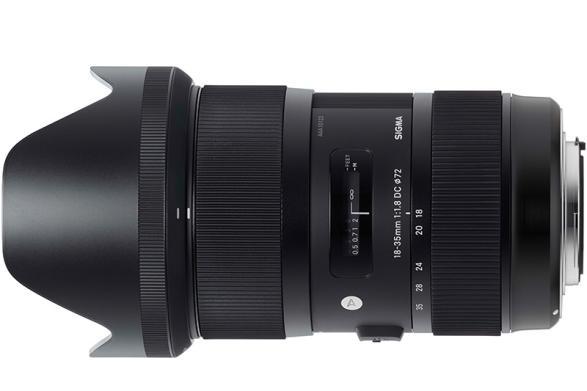
DC。 The acronym for the English word "Digital Compact" refers to a series of lenses designed specifically for small frame sizes, supporting APS-C/4/3 digital camera designs but not for full frame sizes.
DN。 Abbreviation for the English word "Digital Neo", suitable for mirrorless interchangeable lens cameras (MILC/EVIL) with APS-C and micro 4/3 sensor specifications
IF。 The acronym for the English word "Inner Focusing" refers to an internal focusing lens that only moves the internal lens group during focusing, without the need to extend or retract the length of the lens body, resulting in increased stability in operation.
The above is a detailed introduction to the meaning of Sigma lens models. I believe that after reading it, everyone will have a further understanding of Sigma lenses.